Lab kits

Four lab kits. Built to read, built to use.

Half of it

is written to read once.

The other half

is working tools you keep.

You type in your own account, your own stop and your own firm's rules, and every figure recalculates for you. Open a kit again next month with a different account and it answers again. None of them tells you what to trade, and none of them makes a claim about your results.

The complete lab

Evaluation to payout.
The whole route.

From sizing the first trade to keeping a funded account and getting paid from it. Four interactive kits, bought once. The account you enter in one is the account the next one asks about, which is why they are worth owning together rather than one at a time.

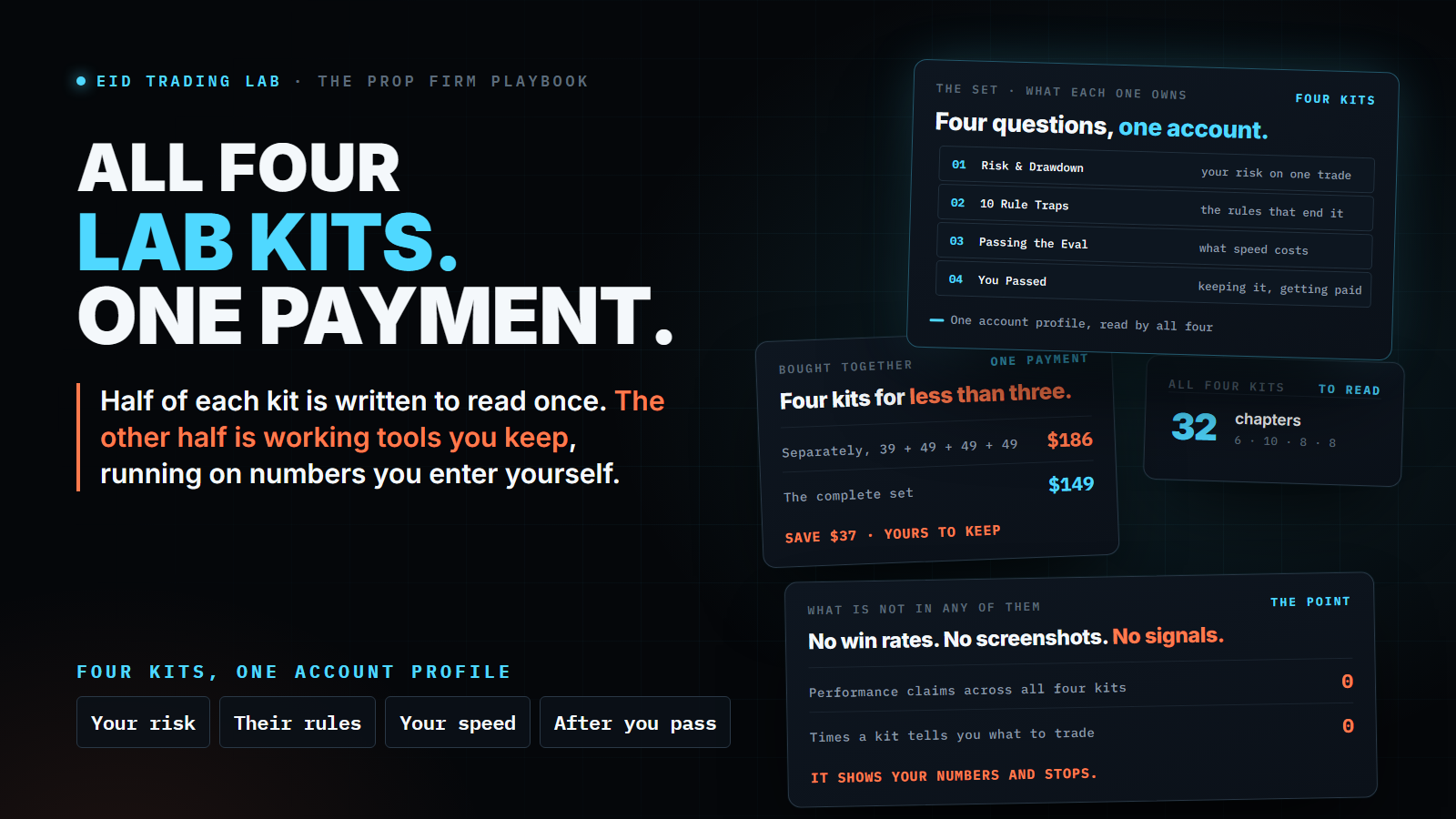
Bought separately$186
The complete set$149
You save$27

One payment, no subscription. Every kit runs in your browser, works offline, and is yours to keep and rerun as often as you like.

The complete set, all four lab kits
Or buy a single kit

Each one stands on its own and answers a different question. Every kit below is the same tool you get in the set.

What it covers · your own risk

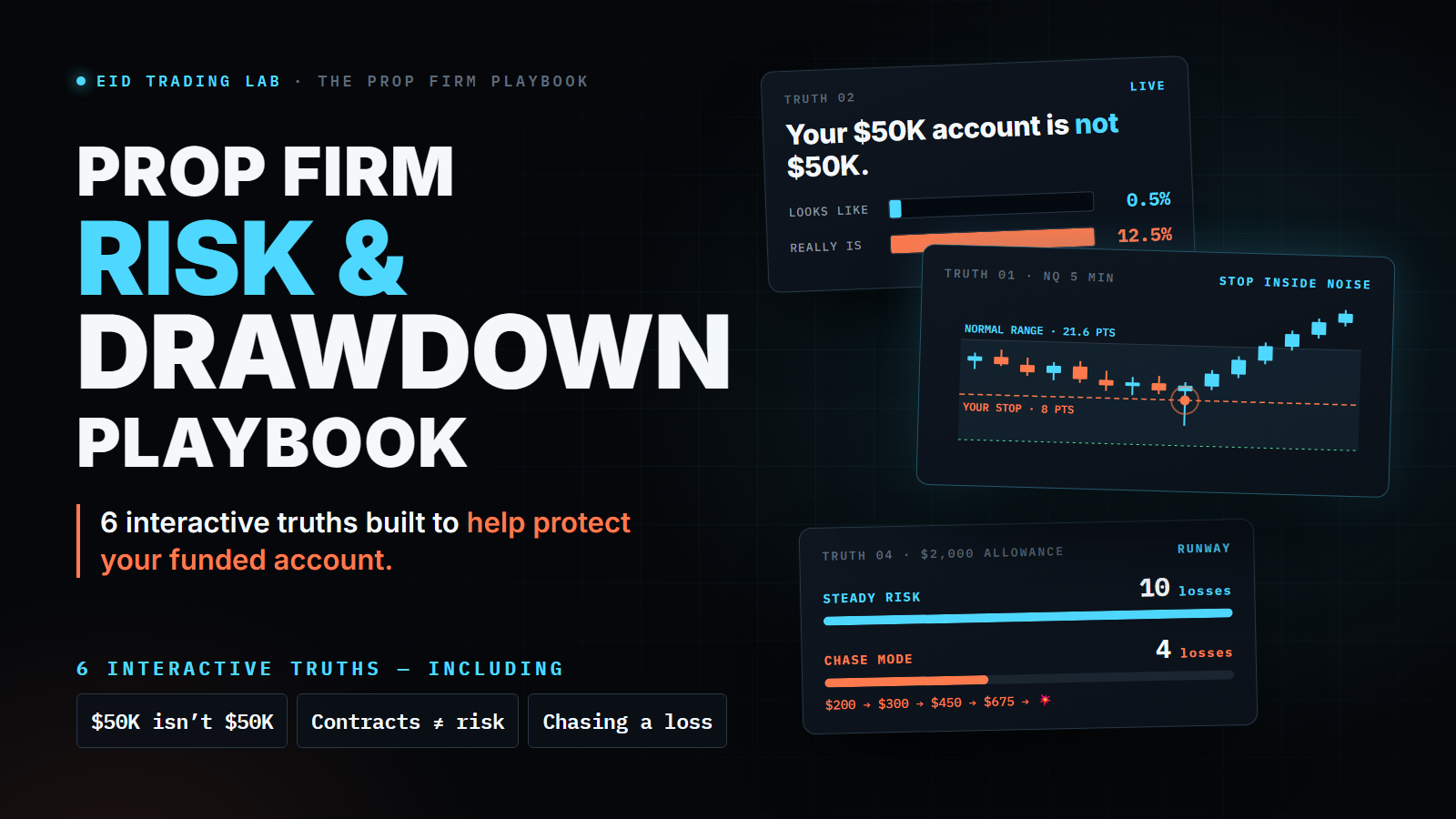
The Risk & Drawdown Playbook.

Not a guide you read once. Six interactive tools, one per trap, that run on your account size, your stop and your drawdown. Type your numbers in and every figure on the page recalculates for your account, not for an example.

$39 One-time purchase · no subscription
interactive, yours to keep
The Prop Firm Playbook, Risk and Drawdown
Inside this lab kitYours to keep · runs in your browser
6Chapters to readEach one states the belief, then shows what the measurement says instead.
9Fields you fill inAccount size, stop distance, contracts, win rate. Your numbers, not an example.
3CalculatorsDollar risk per trade, losing streak odds, and the gain needed to recover a loss.
Times you can rerun itChange the account and every number moves with it. There is nothing to use up.

Read it once. Use it every time you size a trade.

Six rule traps every prop trader should understand

Each one is interactive. You enter your numbers and it recalculates.

01Your stop isn't protectionWhere your stop sits relative to the measured median 5-minute range of the instrument you trade.
02$50K isn't $50KWhat a drawdown rule leaves you in practice, versus the headline account size. The mechanism, free.
03One contract is not a unit of riskWhy fixed contract counts quietly change your dollar risk every time your stop changes.
04A loss does not earn the next trade more riskWhat increasing size after a loss does to the allowance you have left.
05Losing streaks are part of the mathHow long a run of losses a given win rate produces, and what that costs at your size.
06The deeper the hole, the steeper the climbA 20% loss needs a 25% gain. The arithmetic of recovery, at your own drawdown.

What it covers · your firm’s rules

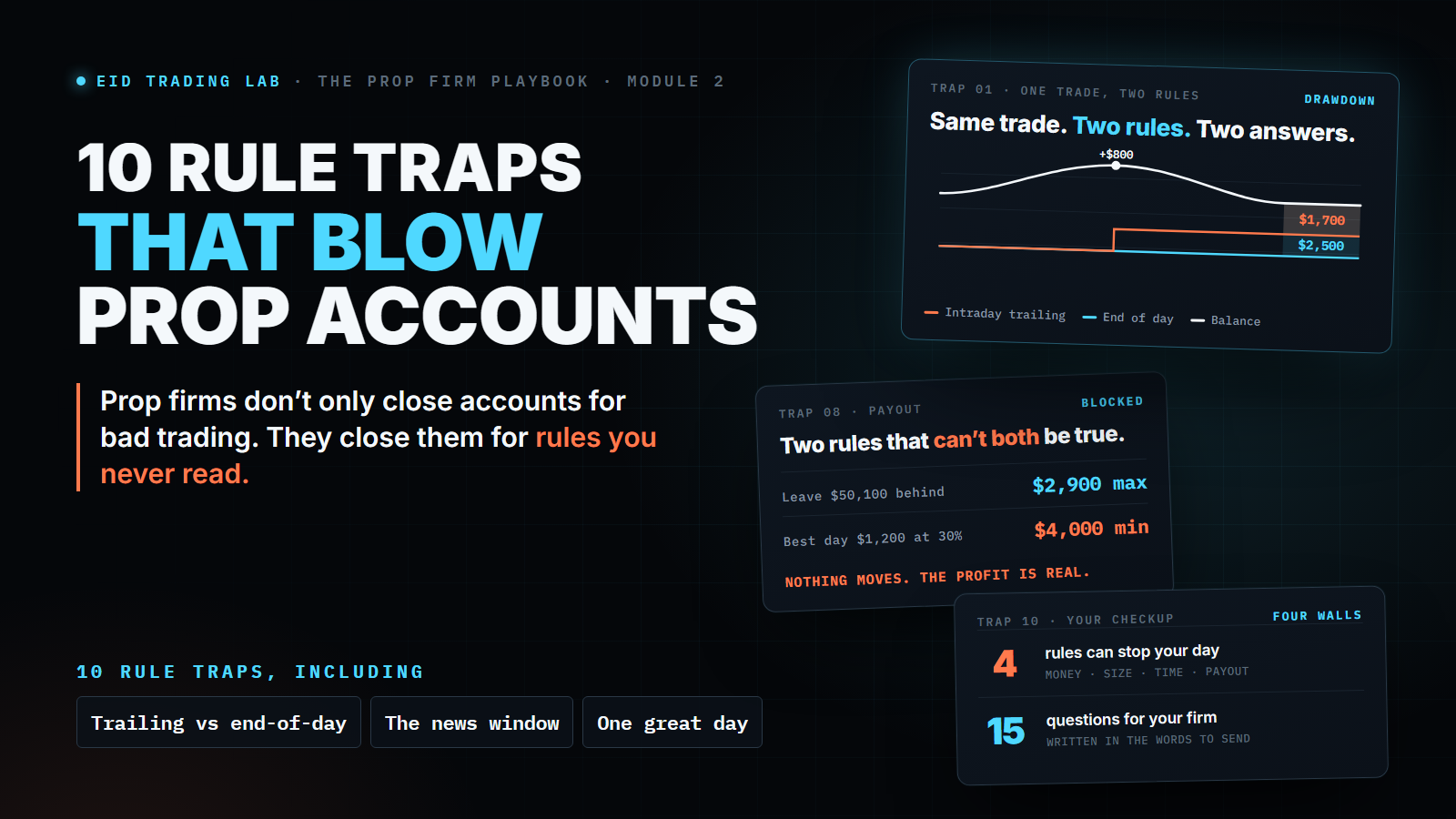
10 Rule Traps That Blow Prop Accounts.

The first playbook is about your risk. This one is about their rules. You enter your firm’s settings once, taken from your own contract, and the ten tools recalculate to show where your real limits sit. Change one setting and every answer moves with it.

$49 One-time purchase · no subscription
interactive, yours to keep
10 Rule Traps That Blow Prop Accounts
Inside this lab kitYours to keep · runs in your browser
10Traps taken apartOne per rule, each showing what it really measures rather than what it says.
34Fields you fill inYour firm’s rule profile, entered once and read by every trap in the kit.
1Operating envelopeAll ten limits checked against each other, so you see which one binds first today.
15Questions to sendWritten in the words to paste to support, for the rules your firm has not published.

Read it once. Use it every time you open an account with a new firm.

What is inside the reading half

Each trap states the belief, shows what the rule actually measures, and recalculates on the profile you enter.

01The line that closes your account can follow you upwardTrailing drawdown, and what it tracks. The mechanism, free.
02Your daily limit is measured from a number you did not chooseThree anchors, three different answers, one morning. The mechanism, free.
03The profit target is not the finish lineTwo distances that are not the same distance.
04The news window is wider than the newsThe trade that was never near the news, and still broke the rule.
05Your maximum size can change under youThe same trader, two sessions apart, two different limits.
06The clock closes your trade, not youThe last entry that clears the close.
07One great day can move the goalpostsOne percentage, three bases, three different answers. The mechanism, free.
08Hitting the target isn't the same as getting paid$3,000 of profit. What actually comes out.
09Not every breach costs the same thingThe same account, sorted by what a mistake actually costs.
10Rules don't fail one at a timeEvery limit checked separately, and never together. One account, one Tuesday, four walls.

Why this one is different

  • Nothing is hardcoded to one firm. You enter your own rule profile and every trap reads from it.
  • Optional rules are tri-state: yes, no, or not sure. A rule you have not checked is never assumed.
  • It ends with an operating envelope, which is all ten limits checked against each other rather than one at a time.

What it is not

  • No market data and no market claims. Every number is either your own input or arithmetic shown on screen.
  • Not a ranking of firms, and not affiliated with any of them.
  • Not signals, not a strategy, and not a promise that any account will pass.

What it covers · how fast you push

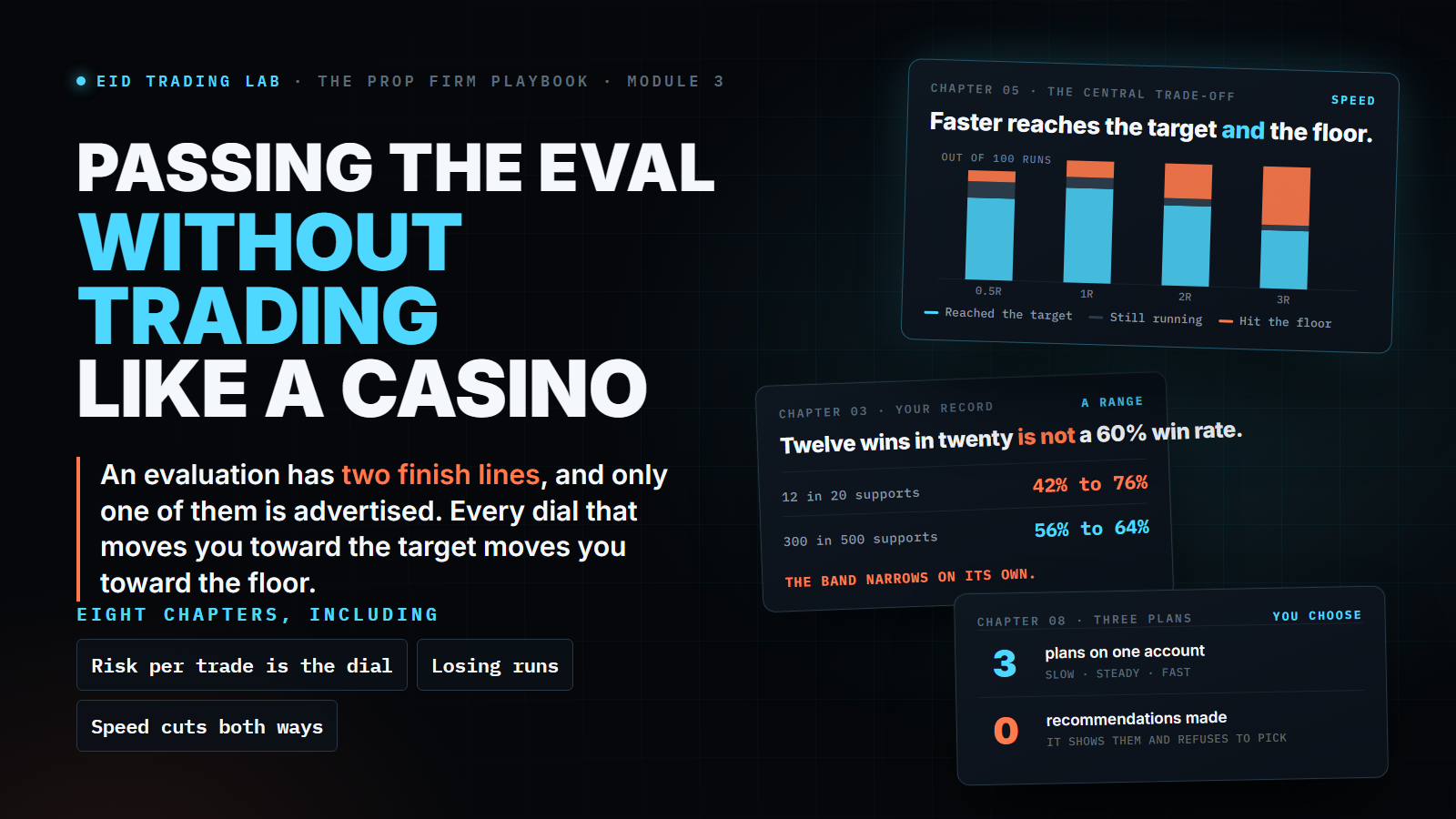
Passing the Eval Without Trading Like a Casino.

The first two are about one trade and about the rules. This one is about speed. An evaluation has two finish lines, the target in front of you and the floor behind you, and every dial that moves you toward one moves you toward the other. Enter your own edge and account, and the simulator shows what your plan actually did across a hundred runs.

$49 One-time purchase · no subscription
interactive, yours to keep
Passing the Eval Without Trading Like a Casino
Inside this lab kitYours to keep · runs in your browser
8Chapters to readThe rule, where traders get it wrong, and the picture that settles it.
2Ways to enter your edgeAssume a win rate, or hand it the trades you actually have and let it widen the answer to match.
100Runs per simulationYour plan, run again and again, counted by how it ended rather than guessed at.
3Plans comparedSlow, steady and fast on one account, and it deliberately does not pick for you.

Read it once. Use it before every evaluation you pay for.

What is inside the reading half

Eight chapters. Each one states the rule, shows where traders get it wrong, and recalculates on the numbers you enter.

01Two finish lines, not oneThe target is advertised. The floor is in the same contract and nobody plans around it.
02Risk per trade is the whole dialSize and stop are one decision. Two contracts with a 30 point stop is a bigger bet than five with a 10 point stop.
03What your record actually tells youTwelve wins in twenty does not mean your win rate is 60%. It means a range, and you can watch the range narrow.
04Losing runs are longer than anyone plans forSizing so four losses in a row survive, in a plan that will produce six.
05Speed cuts both waysRaising risk raises the chance of passing early and the chance of never passing. One edge, four risk levels, three outcomes each.
06The rules cap your speed before the maths doesMinimum trading days and consistency rules put a ceiling on how fast an evaluation can sensibly be passed. The mechanism, free.
07What the simulator is not telling youReached the target in 62 of 100 runs is not a 62% chance of passing, and the chapter shows exactly why.
08Three plans, one accountSlow, steady and fast compared on four measures. It presents all three and refuses to choose for you.

Why this one is different

  • Two input modes, and you pick. Assumed Edge asks what a plan does if your assumption holds. Observed Record takes the trades you actually have and widens the answer to match how thin that record is.
  • A missing field produces no number at all. It never fills a gap with an assumption on your behalf.
  • It ends by showing three plans side by side and deliberately not recommending one.

What it is not

  • It will not tell you how fast to go, or what to risk per trade.
  • It does not predict whether you will pass. A simulation is what a plan did under the assumptions you gave it, nothing more.
  • It never treats a number you guessed as a fact.

What it covers · passing was only the first constraint

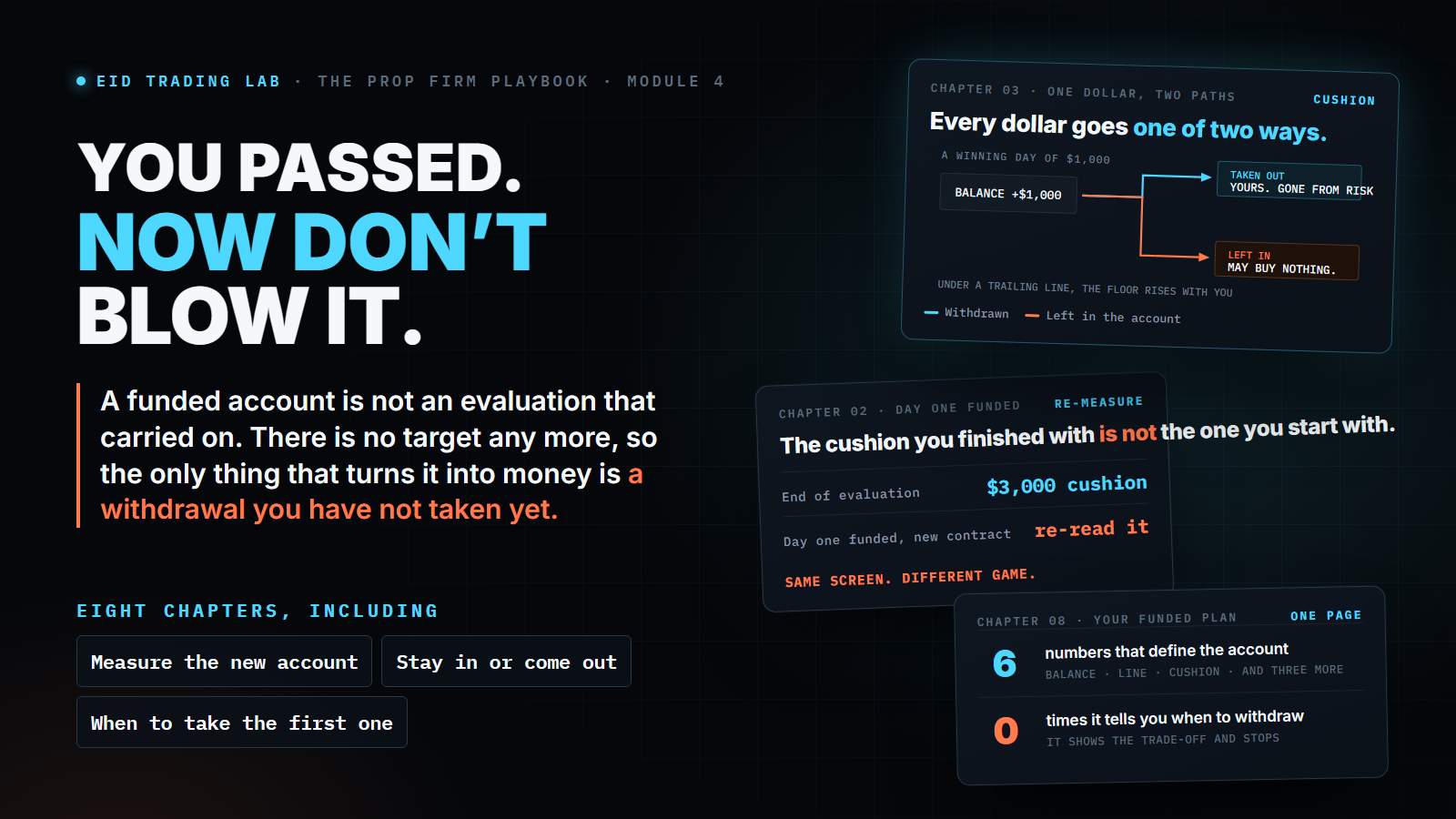
You Passed. Now Don’t Blow It.

The first three kits end at the moment the evaluation is passed. This one starts there. Keeping the account is a different game: there is no target any more, so the only thing that turns it into money is a withdrawal you have not taken yet. Enter your own contract and your own withdrawal policy, and it simulates what that plan does to the account.

$49 One-time purchase · no subscription
interactive, yours to keep
You Passed. Now Don’t Blow It.
Inside this lab kitYours to keep · runs in your browser
8Chapters to readFrom the handover out of the evaluation to a funded plan on one page.
12Contract settings you enterDrawdown, split, cap, consistency, cadence, trading days and the rest. Your document, not an example.
6Numbers that define the accountBalance, line, cushion and three more, named once and used identically everywhere.
0Times it tells you when to withdrawIt shows what each choice does to the account and then stops. The decision stays yours.

Read it once. Use it the week you get funded, and before every payout.

What is inside the reading half

Each chapter states the rule, shows where traders get it wrong, and recalculates on your own contract.

01The account you passed is not the account you haveThe funded contract is a different document. The drawdown can behave differently, and carrying the evaluation plan across unchanged is the first mistake.
02Measure the new account before you trade itOn day one, balance, line and cushion are all re-read from the new contract. Most traders carry the old cushion across in their head and size off a number that no longer exists.
03One dollar, two paths: stay in or come outMoney taken out is yours and out of reach of the rules. Money left in may buy nothing at all, because under a trailing line the floor rises with you.
04The payout you take changes the account you keepA withdrawal is not neutral. What it does to the cushion depends on the contract, and the kit works it out on yours.
05When to take the first oneSooner banks cash from a thinner account. Later leaves money in that may or may not be buying anything. The trade-off shown, the choice left to you.
06Size follows the cushion, or it follows nothingThe link between what the account can absorb and what you are allowed to risk, on the numbers you entered. Kit 01 owns the risk on one trade.
07What this cannot tell youThe honesty chapter. A simulation inherits everything wrong with its inputs, and this one says exactly what it does not know.
08Your funded plan on one pageEight rules, your contract, your policy, and a page you can keep beside the screen.
Why this one is different

  • Six numbers are named once and used identically everywhere, because in a funded account the word "profit" means at least three different things depending on who is asking.
  • It never assumes a winning day buys cushion. Under a trailing line it may buy nothing, and the kit works out which case your contract is in.
  • It simulates thousands of funded accounts on your settings rather than showing one tidy example.

What it is not

  • It will not tell you when to withdraw, how much, or what size to trade.
  • It does not predict that you keep the account. It shows what a policy did across many simulated paths under the assumptions you gave it.
  • It is not a tax, legal or financial opinion about money you take out.

Which one should you buy first?

Three are about losing an account and one is about keeping it. They answer four different questions.

Buy the Playbook if

Your losses are too big

You get stopped out and it costs more than you expected, or a bad run wipes out weeks of work. The question here is how many contracts, and how far away the stop goes. This one does that arithmetic on your account size and your stop. Trap 01 is free, so you can see it before paying.

Buy Rule Traps if

Your trading was fine and the account still closed

You finished green, or barely down, and the firm ended the account anyway. Then the thing that stopped you was a rule, not the market. This one takes the ten rules apart and works out where your real limits sit once you enter the numbers from your own contract.

Buy the funded kit if

You passed and now you are afraid to trade it

You have a funded account and you are either sitting on your hands or trading it exactly like the evaluation. The question here is what a withdrawal does to the account you keep. This one runs your own contract and your own payout policy across thousands of simulated funded accounts.

Buy the Eval guide if

You keep failing evaluations, not trades

You have passed before, or come close, and cannot work out why some attempts end and others do not. The question here is how hard you are pushing, and what that costs. This one runs your plan a hundred times over and shows how often it reached the target, how often it hit the floor, and how long the worst losing run was.

If you are not sure, start with the Playbook. Position size decides how quickly any rule gets reached, so it comes first either way.

All sales are final.

Refund policy

These are digital products delivered immediately after purchase. All sales are final and we do not offer refunds for change of mind once access has been granted or downloading has begun, except where a refund is required by applicable law or by the applicable payment platform or payment-network rules.

The moment payment completes you receive the material in full, downloadable and usable in its entirety. There is nothing left to deliver afterwards and nothing that can be returned.

So check the material first, we would rather you did. Trap 01 of the Playbook is free in full, and the prop firm rule breakdowns on this site cover the mechanism behind several of the Rule Traps at no cost. If that material does not convince you, do not buy.

Payment is processed by Whop, and their terms apply to the transaction alongside this policy.

Read trap 01 free first Read the rule breakdowns

Get them

Built to read. Built to use.

Every kit is half writing and half working tools. You open it in the browser, enter your own numbers, and it recalculates, as many times as you like. One payment, no subscription, delivered immediately through Whop. Their terms and refund policy apply to the transaction.

FORMAT Interactive, runs in the browser PRODUCTS 04 SUBSCRIPTION None YOUR DATA Stays in your browser
Risk disclosure

Trading futures carries a substantial risk of loss and is not suitable for everyone. You can lose your entire deposit, and with leverage you may lose more than you deposit. Do not trade with money you cannot afford to lose.

These products are educational material only. They do not provide signals, account management, financial advice, or any assurance of a trading outcome, and buying one does not make any result more likely. Figures they produce are arithmetic on values you enter, or measurements of past price data, not predictions. Every trading decision, including size and stop placement, is yours alone.

Read the full risk disclosure →