A trailing drawdown is a loss limit that moves up with your account. When you make a new high, the limit follows you up by the same amount. When you give the profit back, the limit does not come back down. What counts as a new high, when the limit updates, and where it stops all depend on the firm’s rules.
So you can finish a day at exactly the balance you started with and have far less room left than you began with. Nothing in your closing balance shows it, which is why this rule ends accounts that look healthy.
A worked example, step by step
Take a $50,000 account with a $2,000 trailing drawdown that tracks closed balance. The limit begins at $48,000 and moves up as new closed-balance highs are established. Here is one ordinary session.
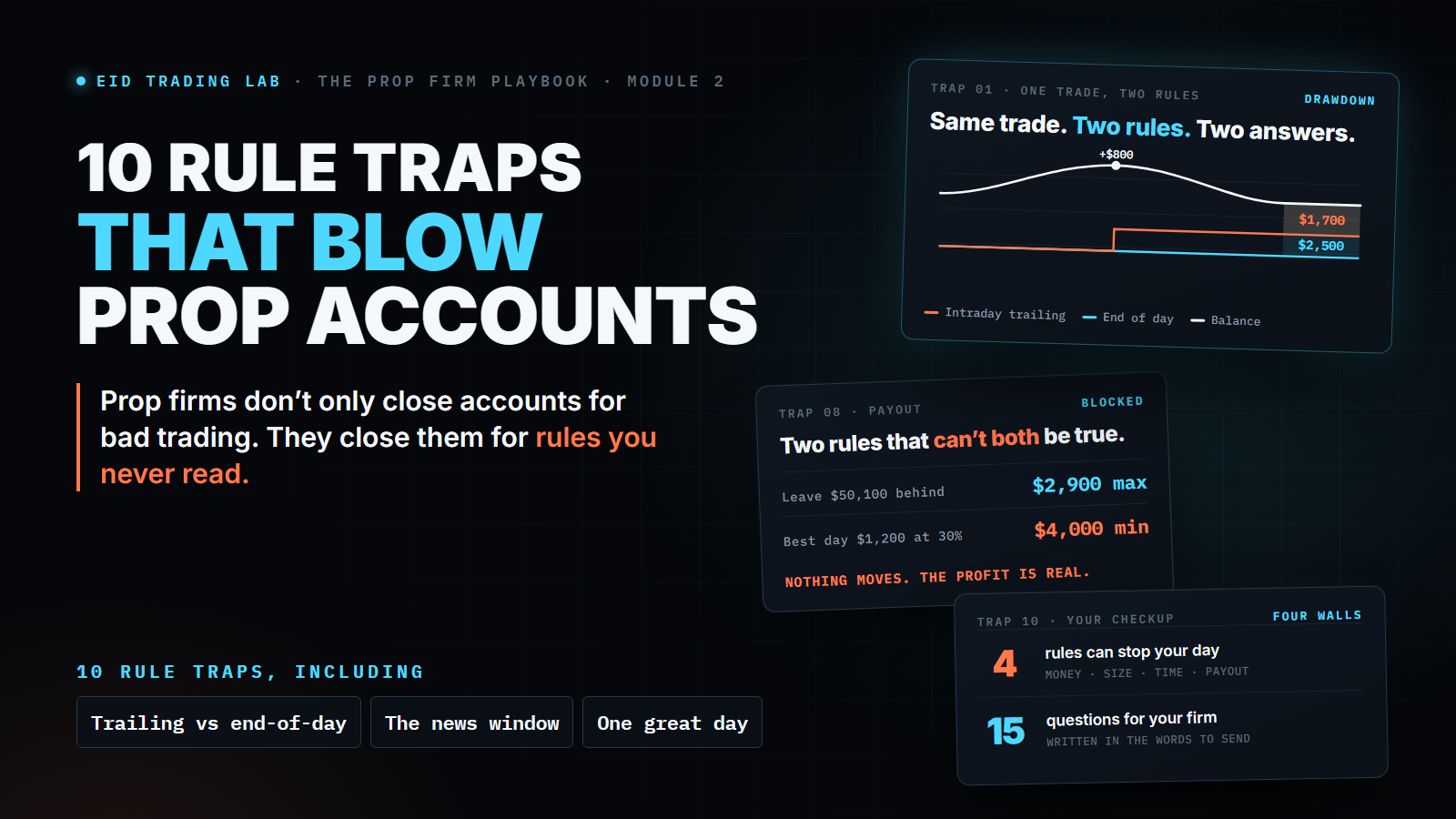
Two traders finish that day at $50,000. The one who was up at 10:40 has $800 of room. The one who sat still has $2,000.
That is the whole mechanism. The profit was temporary; the effect on the limit was permanent. And because the balance column looks identical, most people only discover it on the day the account fails.
Balance or equity: the detail that changes everything
The example above tracked closed balance, which is the friendlier of the two. Many firms track unrealised equity instead, and that is considerably stricter.
Tracks closed balance
Only completed trades move the limit. A trade that goes to +$800 and closes at +$100 moves the limit by $100.
Tracks unrealised equity
The highest point your open position ever reached moves the limit. That same trade moves the limit by $800, even though you only banked $100.
Under an equity-based trail, every unrealised spike you ever sat through has already been deducted from your future room. Letting a winner run and then trailing out of it is expensive in a way the balance never records.
Intraday or end of day
The second detail is when the rule is checked.
End of day
Only your settled balance at the close is compared with the limit. What happened during the session does not matter as long as you finish above it.
Intraday
Every tick counts. A spike against an open position can breach the limit and fail the account on a day you close green.
Intraday checking is why traders sometimes report failing an account on a profitable day. There is no contradiction: the rule was breached at a moment, not at the close.
When does the trail stop moving?
Three common versions, and they are not equivalent:
- It stops at your starting balanceOnce the limit climbs to the account's opening value it freezes there, so the account can never fail below break-even. This is the friendliest version.
- It stops once you are up by the drawdown amountA variation of the same idea, reached slightly later.
- It never stopsThe limit follows every new high for the life of the account, so the distance between your peak and failure stays constant forever.
This single rule is the difference between an account that becomes safer as it grows and one that never does.
Static drawdown, for comparison
A static drawdown sets the failure level once, at the start, and leaves it there. Reach $60,000 on a $50,000 account with a $2,000 static limit and the failure level is still $48,000, so you now have $12,000 of room.
Under a trailing limit the same account has $2,000 of room at $60,000, exactly as it had at $50,000. Neither is better in the abstract. They are different products, and the profit target that looks identical on two firms' websites can mean very different things because of this one line.
Three questions to answer from your own contract
- Does the limit trail my closed balance or my highest unrealised equity?
- Is it evaluated intraday or at end of day?
- Does it stop trailing, and if so at exactly what level?
If you cannot answer all three from your own rule page in under two minutes, that is the finding. Those three answers determine how much room you actually have, and none of them are visible on your account dashboard.
Common questions
Can a trailing drawdown fail my account on a winning day?
Yes, if it is checked intraday. The rule looks at the worst moment of the session rather than the result. A position that moves far enough against you before recovering can breach the limit even though the day closes green.
Does the limit go back down when I lose the profit?
No. That is the defining feature. It moves up with new highs and stays at the highest level it reached, unless the firm's rules say it stops trailing at a stated point.
Is trailing drawdown the same as maximum drawdown?
Not necessarily. "Maximum drawdown" usually names the size of the limit, while "trailing" or "static" describes how it moves. A firm can have a $2,000 maximum drawdown that is either trailing or static, and the two behave completely differently.
Does it matter for position sizing?
It changes what your remaining room actually is, which is the number position sizing should be based on. A trader sizing off the account balance after a profitable morning can be sizing off a number that no longer reflects how much loss the account can absorb.
Which firms use it?
Many, in several variations, and the terms change. We do not rank firms or publish their current numbers, because a figure copied today is wrong next quarter. Read your own contract.
What a green day costs you
The article uses a $50,000 account with $2,000 of room. Put your own account in instead, and one ordinary day: the best your balance reached, and where it finished.
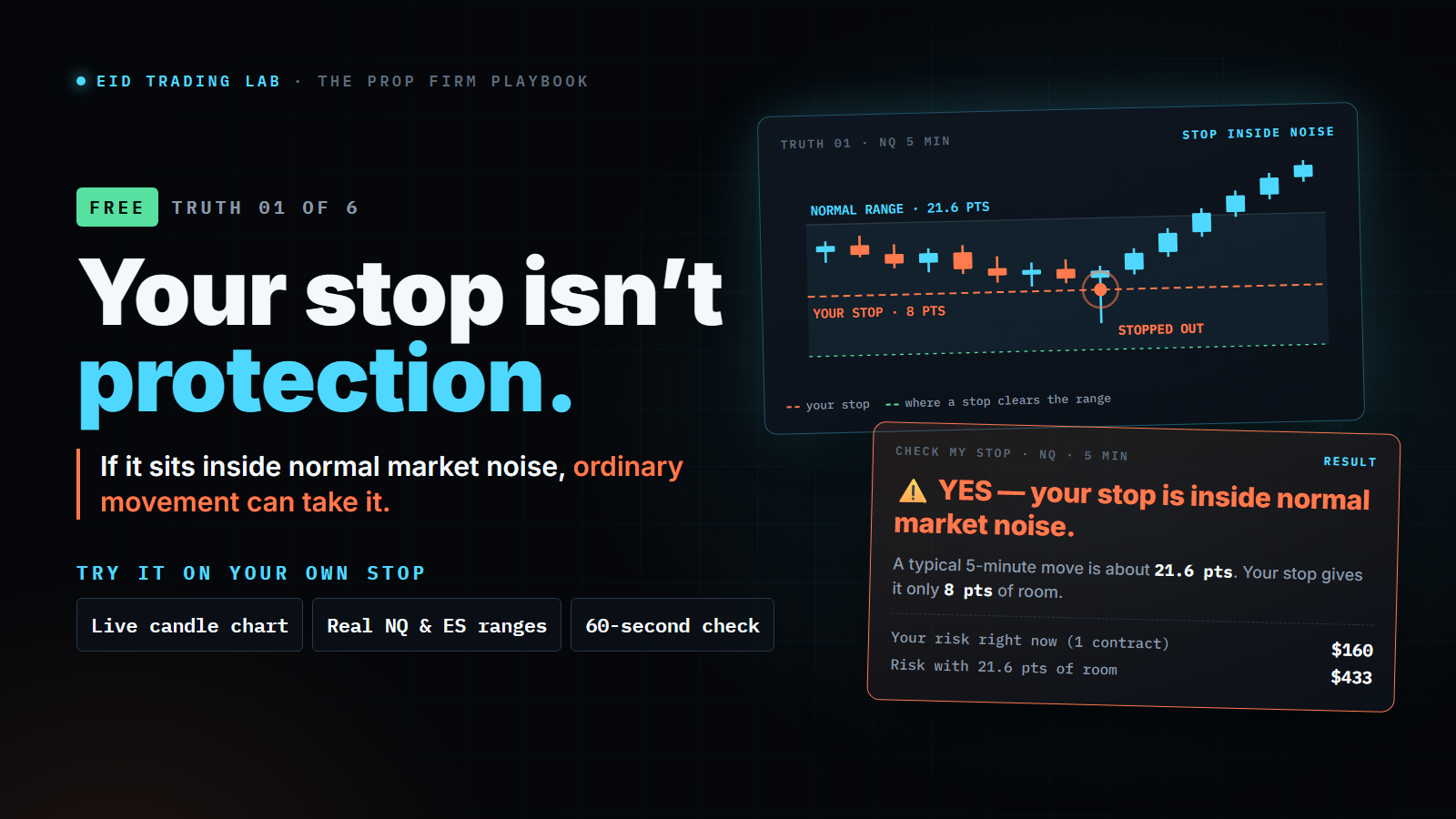
Get the free risk check
The free risk check puts your own account and your stop next to the measured range of a five minute candle on the instrument you trade. It runs in the page, and it costs nothing.
Double opt-in: one confirmation email first, and the check opens after you confirm.
No spam · unsubscribe in one click · we never sell or share your address.
Rather just look first? Open the free risk check.
Related
The other side of the same problem is the size of the moves your account has to absorb. We measured that: half of all regular-session 5-minute NQ candles cover more than 28 points (the study), and a stop smaller than that distance interacts badly with a shrinking drawdown.