The answer first
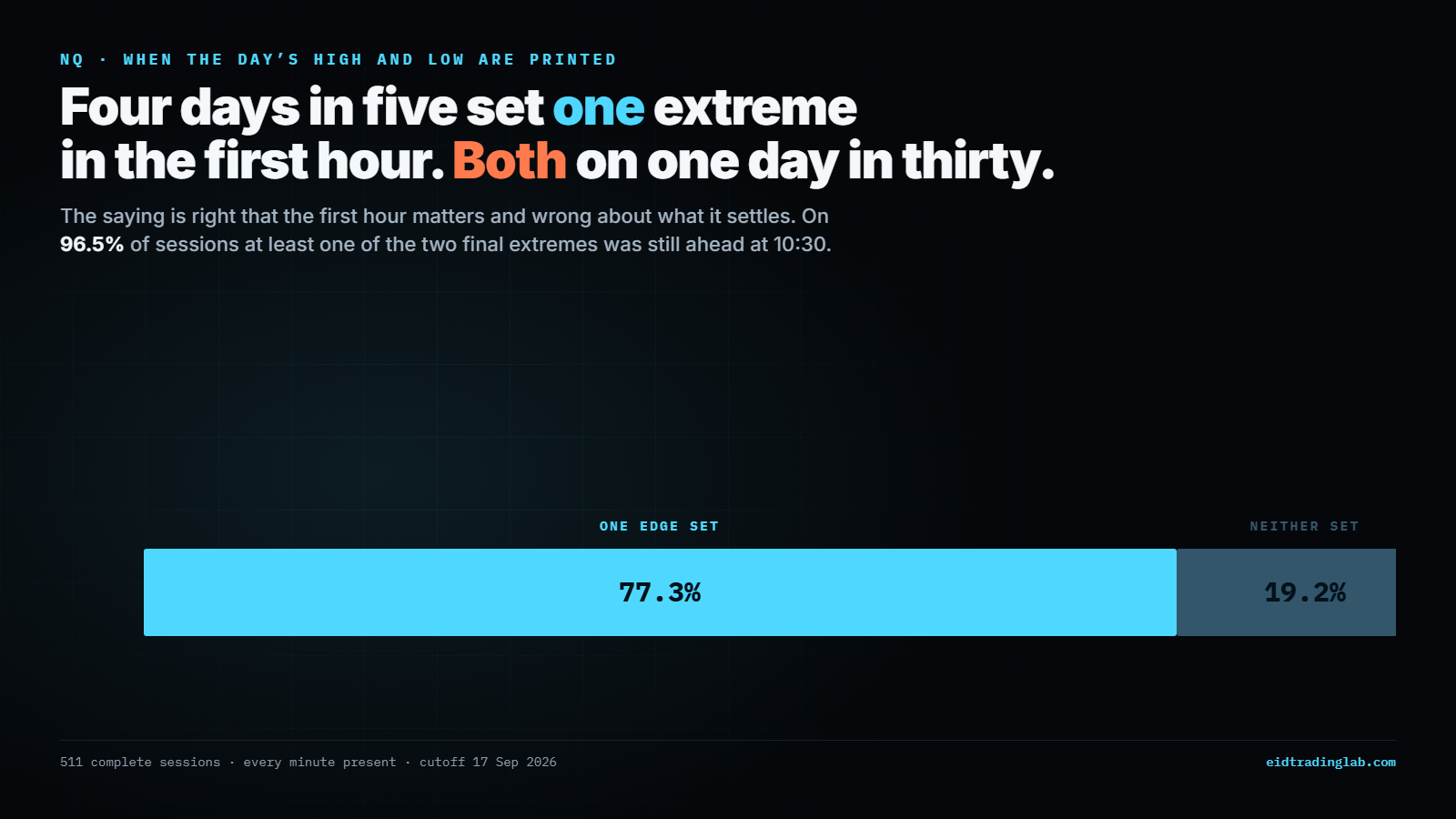
That supports only the weak version of the saying. In 81% of sessions, at least one of the two session extremes was already in place by 10:30. Here is the number that never gets quoted with it:
One edge of the day is usually in early. Both edges almost never are.
The full picture
Each bar is the share of sessions where the condition held. The same measurement, run separately on NQ and ES.
| Window | NQ | ES |
|---|---|---|
| High or low set in the first 30 minutes | 63.6% | 56.6% |
| High or low set in the first 60 minutes | 80.8% | 74.6% |
| High and low both set in the first 60 minutes | 3.5% | 2.0% |
| High or low set in the last 60 minutes | 39.7% | 40.8% |
What the gap between 81% and 3.5% means
The saying is true in a weak sense. On four sessions in five, one of the two extremes is already on the chart by 10:30. It is false in the strong sense people act on, which is that the day's range is essentially complete and the rest is filler.
It is worth splitting that headline properly, because the single figure hides the shape:
- 77.3% of sessions set exactly one of the two extremes in the first hour, and still had to build the other one later.
- 3.5% set both, which is the only case where the day’s range really was finished by 10:30.
- 19.2% set neither, so the final high and the final low were both still ahead.
On 96.5% of sessions, at least one of the two final extremes had not been printed yet at 10:30. That is the honest version of the claim. We previously wrote that "the other edge had not been made yet", which is wrong for the fifth of sessions where neither edge had been made and there was no "other" one to speak of.
The closing hour carries more of that than the saying suggests: on roughly four sessions in ten, one of the two extremes lands in the final 60 minutes. A session that "already did its move" in the morning is, most of the time, still working.
ES behaves the same way, slightly softer
Every figure is lower on ES, and the pattern is identical: 74.6% for one edge in the first hour against 2.0% for both. ES does cover fewer points in a five-minute candle, which we measured in the range study, a median 5-minute ES candle covers 5.75 points against 28.00 on NQ.
Method
- Data cutoff: 17 Sep 2026This study is versioned and frozen at that date. Figures are revised as a new version with its own cutoff, never continuously.
- DataTrade ticks exported through Quantower for XCME-listed instruments, aggregated into one-minute bars by our own code, with recent days taken from the desk’s own live recordings. The methodology page carries the chain from the export onward, the row by row audit, and the part of the chain we cannot show. 747,455 NQ one-minute bars (23 Jun 2024 to 17 Sep 2026) and 716,615 ES one-minute bars (14 Jul 2024 to 31 Jul 2026). Rows sharing an identical bar timestamp are collapsed, keeping the first occurrence, 61,861 such rows were removed from the NQ export and none from ES.
- SessionThe US cash session, 09:30 to 16:00 New York. NQ trades on CME almost around the clock, so this is a chosen window rather than the instrument’s own trading hours. Overnight is excluded entirely.
- TimingFor each session we take the timestamp of the highest high and of the lowest low inside the session, then test whether each falls within the window being measured. "First 60 minutes" means 09:30 up to but not including 10:30.
- What counts as a sessionA complete session is 390 one-minute bars, 09:30 through 15:59. A session is included only if every one of those 390 minutes is present, checked against the expected grid rather than by counting rows. That leaves 511 NQ and 493 ES sessions. An earlier version accepted any session with at least 350 bars, which allowed a day to be missing up to forty minutes, and for a study about when an extreme is printed the missing stretch could have contained it.
- Sensitivity to that choiceUnder the old rule the NQ figures were 81.0% and 3.4% on 522 sessions; under the strict rule they are 80.8% and 3.5% on 511. Tightening the filter moved the headline by two tenths of a point, so the result is not an artefact of how generous the rule was. Both runs are published.
- How precise these areOn 511 sessions, the 95% interval around 80.8% is 77.4 to 84.2, and around 3.5% it is 1.9 to 5.1. Read them as "about four in five" and "about one in thirty", not as constants.
- TiesWhere the extreme value occurs on more than one bar, the first occurrence is used. A session that touches its high at 09:45 and again at 15:40 is therefore counted as having set it in the first hour.
What this does not prove
Knowing that an extreme is often set early tells you nothing about which extreme it was, which direction the session then took, or whether any level will hold. It is a statement about timing, not about direction, and certainly not about tradability.
It also says nothing about the distance involved. A session can set its high in the first ten minutes and then spend the day two points below it. Timing and magnitude are separate measurements, and this study only covers the first.
And it describes the period measured. Two years is enough to be meaningful and not enough to be permanent; a different volatility regime would move these figures. That is why the study is versioned rather than continuously updated.
How often was the day decided while you were at the screen?
The measurement is about windows, so this asks which window you are in. Choose the part of the session you actually trade and how many sessions you sit for in a month, and it turns the measured share into a count of sessions.
The other half of the question
Knowing when the day is decided is only useful if your stop survives the part you are present for. The free check puts your stop next to the measured range of a candle in the same session.
Risk & Drawdown Playbook
Timing is one measurement. The kit is the six that decide an evaluation, each a tool you type your own account into, with the firm rules that shrink your room applied on top.
Related
If one edge of the day is usually set in the first hour, the size of the moves in that hour is the other half of the question. The median 5-minute NQ range at 09:30 is 52.25 points, more than double the early-afternoon figure, which is what makes the opening hour both the most likely place for an extreme and the most expensive place to be wrong about a stop.